  
|
Posted By SDA National,
Wednesday, April 1, 2026
Updated: Wednesday, April 1, 2026
|

Subconsultants are essential to delivering successful projects—but managing them well is where operational excellence is truly tested, and where small breakdowns can quietly erode profitability and relationships alike.
At a recent SDA Roundtable, members came together for a candid conversation about the realities of subconsultant coordination: what's working, what isn't, and where firms are feeling the most pressure. The discussion made one thing clear—the technical work rarely creates the biggest headaches. It's the business side of subconsultant management that demands the most attention, and for many firms, that's an area still in need of refinement.
Where Firms Are Feeling the Pressure
Invoicing and financial tracking consistently surfaced as a top frustration. Missing project information, delayed submissions, and the manual effort required to reconcile subconsultant billing all contribute to cash flow uncertainty that compounds over time. Even firms with dedicated project management software often find themselves relying on spreadsheets to fill the gaps—a clear sign that tools alone aren’t solving the underlying process problems.
Scope creep was equally common—and costly. Work performed without clear authorization often goes undetected until the invoice arrives, at which point the conversation becomes difficult for everyone involved. In many cases, the issue isn't a subconsultant acting in bad faith; it's a project manager or team member making informal requests outside of established channels. Preventing it requires more than a well-written contract. It requires consistent internal communication and clearly defined approval processes that everyone on the team understands and follows.
Communication breakdowns extend further than scope management. Several members raised concerns about subconsultants interacting directly with clients without routing through the prime—a dynamic that blurs accountability, creates misalignment, and introduces real risk. Even when contracts specify communication protocols, real-world behavior doesn't always follow. Firms that have had the most success here address expectations explicitly at project kickoff, not just in the agreement itself.
Payment practices and insurance compliance rounded out the most commonly cited pressure points. The 'pay when paid' approach remains widespread, but its application varies considerably from firm to firm—and most members acknowledged that payment strategy is as much a relationship decision as a financial one. On the compliance side, tracking Certificates of Insurance across multiple subconsultants is still a largely manual process for many firms, and one that tends to be reactive rather than proactive.
What's Actually Working
Despite these challenges, the roundtable surfaced several practices that are making a meaningful difference—practical shifts that firms can implement right away. Project kickoff meetings that bring together PMs, accounting, and subconsultants early on consistently reduce downstream friction. Standardized contract templates—particularly firms moving toward their own agreements rather than signing subconsultant terms—provide stronger footing on scope, payment, and compliance from the start.
Regular internal check-ins help surface issues before they escalate, and centralized tracking systems, even imperfect ones, provide a single source of truth that scattered email threads simply cannot. Across the board, the firms navigating subconsultant relationships most effectively have invested in clear roles, documented expectations, and repeatable processes that don’t rely on institutional memory to function.
The most important takeaway may be this: most subconsultant challenges aren’t really about the subconsultants—they’re about us. They’re about the communication habits and internal consistency within our own firms—and those are things we have the ability to improve.
Hear the Full Conversation
Want to hear how your peers are tackling these challenges in real time? The full Roundtable recording dives deeper into the tools, workflows, and real-world scenarios shared during the discussion. Purchase the recording from the SDA Store and walk away with practical ideas you can apply immediately.
Question: How is your firm managing subconsultants—and where are you feeling the pressure? We’d love to hear what’s working for you. Tell us in the comments below.
Tags:
AEC Industry
Design Firm Operations
Roundtable Recap
SDA National
Subconsultant Management
Permalink
| Comments (0)
|
|
|
Posted By Jennifer Greene, CDFO,
Tuesday, March 31, 2026
Updated: Tuesday, March 31, 2026
|

SDA’s transition from Certified Design Firm Administrator (CDFA) to Certificate in Design Firm Operations (CDFO) reflects the evolving leadership role of today’s design firm professionals. To recognize the strength of the original CDFA, existing holders completed only the new Leadership section of the exam. Those who passed earned the CDFO—demonstrating both deep operational knowledge and the leadership skills shaping the future of the profession.
Penny Nelson, FSDA
Chief Financial Officer at Douglas Pancake Architects, Inc.
What inspired you to pursue the CDFO certification after having received your CDFA?
As an SDA Fellow, I felt that I needed to set a good example for the members. I also like to keep current with my certifications.
How has earning your CDFO credential impacted your confidence, skills, or credibility in your role?
It has given me some great insight into the leaders of our firm, as well as understanding my own leadership style and what I need to do to enhance my skills.
Were there any doubts or hurdles you had to overcome in deciding to take the Leadership Section? How did you move past them?
I haven't had to study for an exam since obtaining my CDFA. I'm used to studying for facts, and this section is more about theory, so it was a bit more difficult to solidify the information in my head.
What surprised you most about the preparation or exam process?
The theoretical aspect of the section. I didn't realize I would struggle with that.
Did you engage with the Path2Success program, CDFO Study Group, mentor, or other resources? If so, how did it help?
No.
What topic or section challenged you the most--and how did you tackle it?
Understanding the subtle differences between the 21 laws was a challenge.
How have your employer or colleagues responded to your certification?
Just congratulations, nothing more.
What would you say to someone in the A/E industry who is unsure if the CDFO credential is worth it?
Obtaining the CDFO provides an instant confidence boost! You have proven your expertise in the industry.
Tags:
AEC Leadership
AEC Operations
CDFO
Certificate in Design Firm Operations
Design Firm Operations
Get Certified
SDA Fellow
Permalink
| Comments (0)
|
|
|
Posted By SDA National,
Tuesday, March 24, 2026
Updated: Tuesday, March 24, 2026
|

Thinking Outside the Box: Employee Engagement in Action
Guest Contributor: Rich Friedman, Friedman & Partners
SDA is always looking for ways to bring fresh perspectives to our members. We’re pleased to share this guest contribution from Rich Friedman, who explores how A/E/C firms are rethinking employee engagement in meaningful and lasting ways.
In an era defined by labor shortages, generational change, and rising employee expectations, engagement has become one of the most powerful drivers of retention, recruitment, and long-term stability.
But leading firms aren’t relying on generic programs. Instead, they’re creating distinct, firm-specific approaches that give employees a voice, reinforce values, and build real connection.
Here are three examples of what that looks like in action.
Recognition as Culture: Bergmeyer’s Unicorn Awards
At Bergmeyer, engagement starts with recognition—and not the top-down kind.
Their “Unicorn Award” is a monthly, peer-nominated program open to everyone in the firm. Employees nominate colleagues who demonstrate creativity, collaboration, or going above and beyond.
Rather than being a marketing initiative, the program is intentionally internal. Winners are celebrated at all-hands meetings and receive a custom handmade award, reinforcing that recognition is personal and meaningful.
What makes it work?
- Peer-driven, not leadership-selected
- Inclusive across all roles
- Embedded into regular firm rituals
The result is a culture where people feel seen—not just for results, but for how they contribute.
Engagement Through Structure: MKSK’s Staff Council
MKSK takes a different approach—focusing on structure and voice.
After transitioning to a 100% ESOP, leadership recognized that while ownership had expanded, decision-making had not. Their solution: a Staff Council representing employees across offices and levels.
The council meets regularly, gathers feedback through informal conversations, and brings real issues to leadership—ranging from benefits to workplace policies.
What makes this effective:
- Direct line between staff and leadership
- Rotating participation to broaden involvement
- Transparency about what can (and can’t) be implemented
An unexpected benefit?
The council has become a leadership development pipeline, giving emerging professionals insight into how decisions are made.
Stepping Away to Reconnect: The MKSK Design Summit
MKSK also invests in connection at a firmwide level through its annual Design Summit.
This two-day event brings employees together from across offices for:
- Project tours and learning sessions
- Peer connection and mentorship
- External speakers outside the firm’s daily work
While the investment is significant, the return is clear:
Stronger relationships, shared identity, and a sense that employees are part of something bigger.
As one leader put it:
“It feels like a conference—but it’s ours. And that distinction matters.”
Different Approaches, Same Outcome
While these examples differ in style—from playful recognition to structured governance—they share one critical trait:
Intentionality.
Each firm has built engagement strategies that reflect its culture, not someone else’s template.
Engagement as a Strategy, Not an Add-On
The most successful firms don’t treat engagement as an HR initiative or occasional program.
They embed it into:
- How decisions are made
- How recognition happens
- How leaders show up every day
There’s no one-size-fits-all solution—but there is a common principle:
- Understand what your people value
- Create ways for them to be heard
- Reinforce it consistently
In today’s market, firms that do this well aren’t just improving culture—they’re building organizations people want to stay with.
Join the Conversation
What unique employee engagement strategies have worked in your firm?
Share your ideas in the comments—we’d love to continue the conversation and highlight additional approaches from across the SDA community.
This article has been adapted for SDA members from an original piece by Rich Friedman.
👉 Read the full article here: Outside the Box Employee Engagement
Tags:
AEC Industry
Design Firm Operations
Employee Engagement
Guest Blog
Leadership
SDA National
Talent Retention
Workplace Culture
Permalink
| Comments (0)
|
|
|
Posted By Jennifer Greene, CDFO,
Tuesday, March 24, 2026
Updated: Tuesday, March 24, 2026
|
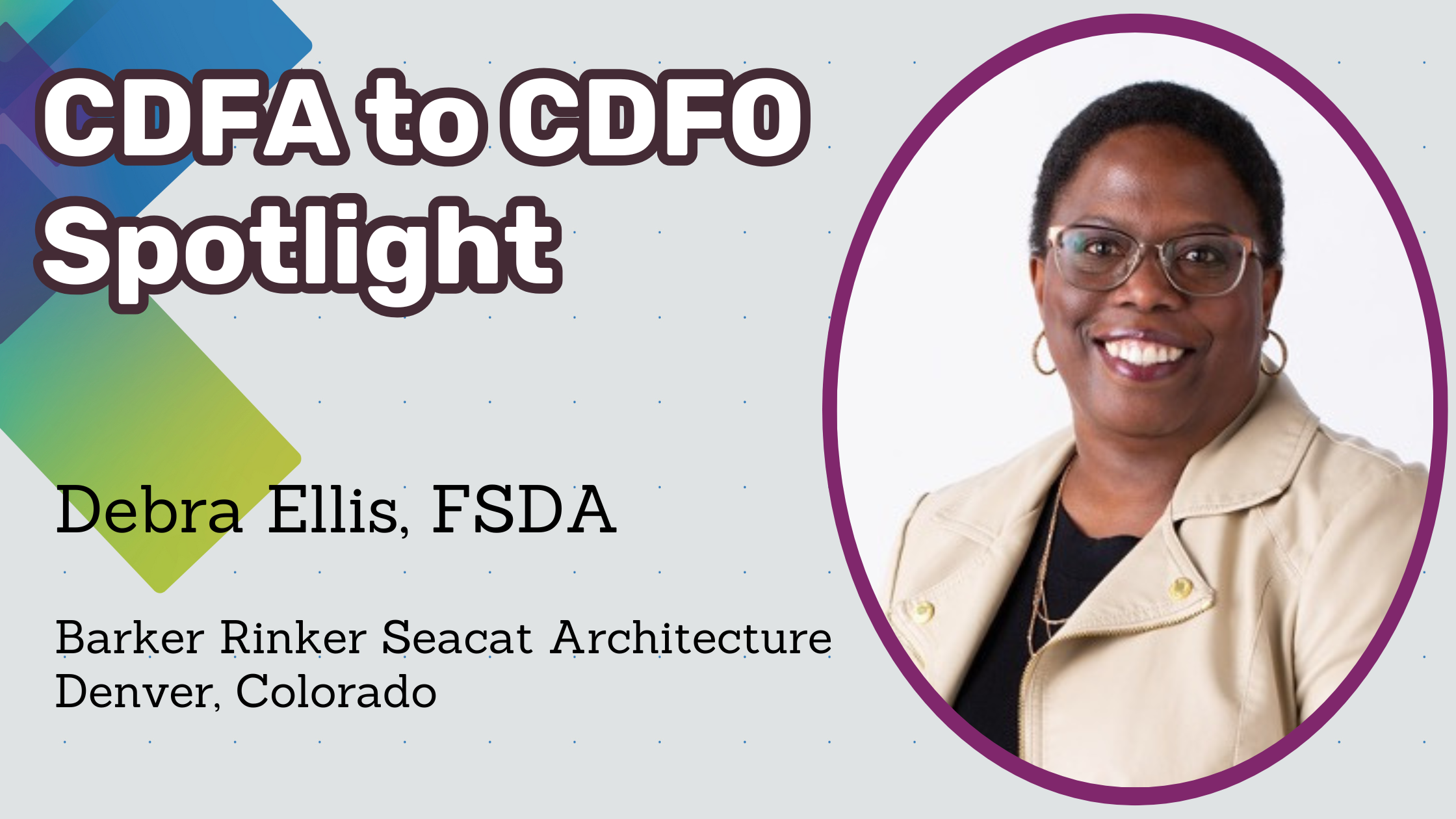
SDA’s transition from Certified Design Firm Administrator (CDFA) to Certificate in Design Firm Operations (CDFO) reflects the evolving leadership role of today’s design firm professionals. To recognize the strength of the original CDFA, existing holders completed only the new Leadership section of the exam. Those who passed earned the CDFO—demonstrating both deep operational knowledge and the leadership skills shaping the future of the profession.
Debra Ellis, FSDA
Office Manager, Barker Rinker Seacat Architecture
What inspired you to pursue the CDFO certification after having received your CDFA?
I felt that, as a Fellow in the organization, I should take the next step and complete this certification.
How has earning your CDFO credential impacted your confidence, skills, or credibility in your role?
This is one more credential that I have earned that I am very proud of. It shows my hard work over the years, especially since I did not complete college, and has been worth it.
Were there any doubts or hurdles you had to overcome in deciding to take the Leadership Section? How did you move past them?
The only doubt that I had was that I am not a very good test taker. However, I knew I was prepared since I had participated in the Path2Success program, so I knew the material.
What surprised you most about the preparation or exam process?
I was not surprised by the preparation of the exam process. Again, because I had participated in the Path2Sucess program.
Did you engage with the Path2Success program, CDFO Study Group, mentor, or other resources? If so, how did it help?
The Path2Success program is given by the Fellows, so yes, I participated in the program. This allowed me to read the book and join in the discussions, which helped me to understand the information in the book and the test.
What topic or section challenged you the most--and how did you tackle it?
I can't think of any specific section.
How have your employer or colleagues responded to your certification?
They celebrated in the office.
What would you say to someone in the A/E industry who is unsure if the CDFO credential is worth it?
I think that any credentials that the Administrative, HR, Accounting, and Marketing staff can achieve in the A/E/C industry, they should pursue. It helps to bring credibility to you, your position in your firm, and to SDA.
Tags:
AEC Business
AEC Operations
CDFO
Certificate in Design Firm Operations
Design Firm Operations
Get Certified
SDA Fellow
Permalink
| Comments (2)
|
|
|
Posted By Innovations in Education Committee,
Thursday, March 19, 2026
Updated: Thursday, March 19, 2026
|

What Is Servant Leadership?
Servant Leadership is a leadership style that prioritizes the growth, well-being, and empowerment of others. While traditional leadership often emphasizes organizational success first, servant leadership flips the perspective: it exists to serve people, ensuring the organization succeeds through their success.
First introduced by Robert K. Greenleaf in the 1970s, servant leadership has since been widely adopted across industries for its ability to foster healthier, more engaged workplaces. For administrative staff in the AEC industry, this approach resonates deeply. Operations personnel, whether in accounting, project management, marketing, or administration, often lead by building trust, fostering collaboration, and ensuring that projects and people succeed together, hallmarks of servant leadership.
We can express it simply as Compassion, Character, and Competence—or expand it into ten guiding principles.
Ten Principles of Servant Leadership
- Listening – Ask questions and truly listen. Conversations reveal needs, build trust, and spark solutions.
- Empathy – Understand the perspectives and emotions of your colleagues to create a supportive environment.
- Healing – Address conflict with patience and compassion. True servant leaders model resilience by practicing self-care as well.
- Awareness – Know your own strengths, blind spots, and biases. Self-reflection helps align actions with your team’s best interests.
- Persuasion – Influence through reasoning and trust, not authority. Inspire buy-in for shared goals.
- Conceptualization – See the bigger picture. Look beyond day-to-day operations to envision what’s possible and set ambitious goals.
- Foresight – Use intuition and experience to anticipate challenges and prepare your team to navigate them.
- Stewardship – Act as a caretaker of your organization and people. Stewardship builds trust and empowers others to succeed.
- Commitment to Growth – Invest in your team’s skills, knowledge, and confidence. When people grow, so does the firm.
- Building Community – Strong teams are built on trust and connection. Nurturing relationships creates a culture of collaboration and belonging.
Why It Matters for Operations Personnel in A|E|C
In the Architecture, Engineering, and Construction industry, operational staff are often the connective tissue that holds projects together. By practicing servant leadership, operations personnel don’t just manage tasks; they:
- Elevate others by anticipating needs and removing obstacles.
- Foster collaboration across disciplines, strengthening project outcomes.
- Model resilience and adaptability, inspiring others to do the same.
- Build inclusive communities where diverse voices and ideas can flourish.
Research shows servant leadership is especially effective when practiced with empathy and mentoring. Studies even suggest women often excel in these areas, an insight that resonates strongly with the operations personnel who form the backbone of A|E|C firms. Servant leadership is not just a philosophy but a lived reality for many SDA members.
Pitfalls of Overextending as a Servant Leader
Like all leadership approaches, servant leadership requires balance. Without it, even the best intentions can create challenges. Common pitfalls include:
- Neglecting Self-Care – Always putting others first can lead to burnout. Leaders must serve from a place of strength, not exhaustion.
- Over-Accommodating Others – Compassion without accountability can enable unhealthy dynamics or allow underperformance to persist.
- Creating Dependence – Solving every problem for others may prevent colleagues from developing independence and confidence.
- Losing Sight of the Big Picture – Focusing too much on individual needs can sometimes overshadow organizational goals.
How to Stay Balanced
- Protect time for your own renewal and growth.
- Pair empathy with clear expectations.
- Coach others to find solutions rather than rescuing them.
- Keep support aligned with both team and organizational priorities.
For operations personnel in the A|E|C, often seen as the “fixers” in their firms, acknowledging these boundaries ensures that servant leadership is both sustainable and effective.
Real-World Inspiration: Shared Leadership at Onyx Creative
At Onyx Creative, Carole Sanderson, CDFA, exemplifies servant leadership at a 50-year-old architecture and engineering firm based in Cleveland, OH. Rising through finance and operations ranks, she became CFO, sharing leadership with the President and guiding the firm through several acquisitions to expand its size, footprint, and services. Their profit-sharing approach, rooted in employee engagement and trust, demonstrates how servant leadership can break traditional methodologies, marry the front and back offices, and inspire new ways of leading in architecture.
Take Action: Who Will You Serve Next?
Servant leadership isn’t just a theory; it’s a practice. Here’s a simple exercise to put it into action:
- I will mentor: ________________________ (Name of colleague or team member)
- Why I chose this person: ____________________(Their potential, interest, or unique need)
- What I have to offer: ___________________ (Skills, experiences, or insights you can share)
- Three ways I can add value: ____________________________________________ (Examples: training on tools, career guidance, confidence building)
- We will meet: (Once each / every other week for ___ months)
This intentional commitment transforms relationships and demonstrates the heart of servant leadership: serving others so that together, we all succeed.
Closing Thought
Operations personnel in the A|E|C industry have long led through service by supporting leaders, guiding projects, and mentoring peers. Servant leadership simply names and elevates what many SDA members already embody: leadership rooted in empathy, trust, and growth. By practicing these principles while also caring for themselves, A|E|C operations personnel not only empower their teams but redefine what effective leadership looks like in our industry.
References
SDA does not endorse any products or services mentioned, and SDA does not assume responsibility for any circumstances arising out of the interpretation, application, use, or misuse of any information presented. SDA recommends that the reader consult the appropriate legal, financial, or human resource counsel before implementing the information contained herein.
Tags:
AEC Leadership
AEC Learning
AEC Mentoring
SDA National
Permalink
| Comments (1)
|
|

 Blog Home
 All Blogs
 RSS
RSS